
Neurodivergent Systems Therapy (NST)
A Neurodivergence-Affirming Psychotherapy Framework
Neurodivergent Systems Therapy (NST) is a neurodivergence-affirming psychotherapy framework developed by Justyna Kulczyk Lewinska to support clinicians working with neurodivergent adults across psychological, relational, and psychosexual contexts.
NST offers an integrative approach to understanding neurodivergent experience by bringing together insights from neuroscience, nervous system regulation research, relational psychotherapy, and the neurodiversity paradigm. The framework recognises that neurodivergent experience cannot be fully understood through behavioural descriptions alone, but must be considered in relation to neurological processing, emotional experience, relational dynamics, adaptive strategies, and social environments.
Rather than approaching neurodivergence as a deficit to be corrected, NST understands neurological diversity as a natural variation in human cognition, perception, and regulation. The framework supports therapists in developing clinical formulations that recognise how neurodivergent processing interacts with environments, relationships, and identity over time.
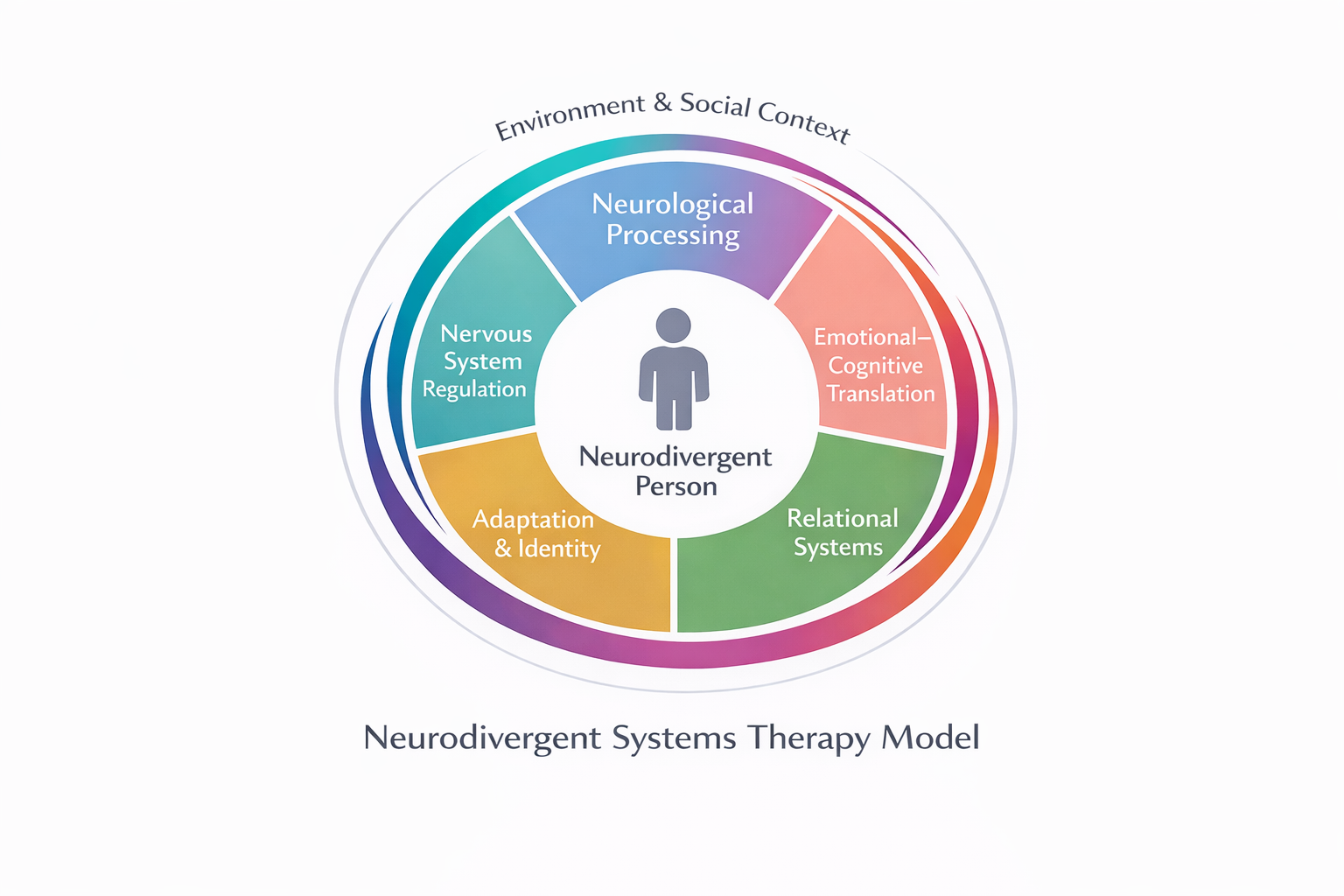
NST provides clinicians with a structured way of understanding neurodivergent experience through interacting systems while maintaining flexibility for individual differences and therapeutic approaches.
The aim of Neurodivergent Systems Therapy is to support therapists in creating therapeutic spaces that foster understanding, relational trust, agency, and sustainable ways of navigating environments and relationships.
The Five NST Systems
Neurological Processing
1
This system refers to the ways in which the brain processes information, attention, and sensory input.
It includes patterns such as attention regulation, hyperfocus, executive functioning differences, sensory processing patterns, and variations in time perception.
Understanding neurological processing helps therapists appreciate how neurodivergent individuals perceive, organise, and interpret the world around them.
Clinical exploration within this system focuses on questions such as:
• How does the client process information and sensory input?
• What patterns of attention and cognitive focus are present?
• How do executive functioning and time perception shape daily experience?
Many clients hold both autistic and ADHD profiles at once, sometimes with directly conflicting needs, such as a pull toward predictability alongside a pull toward novelty. NST treats this as its own distinct pattern to be understood, not two separate diagnoses layered on top of each other.
This system focuses on physiological regulation and stress responses.
Neurodivergent nervous systems may have different activation thresholds, sensory sensitivities, and recovery patterns following stress or overload.
NST explores how regulation patterns influence emotional experience, energy levels, relational engagement, and capacity over time.
Clinical exploration may include:
• sensory overwhelm and shutdown states
• patterns of hyperarousal or anxiety
• rejection sensitivity
• capacity fluctuations and burnout cycles
Nervous System Regulation
2
This system explores how internal emotional experiences are recognised, interpreted, and communicated.
Many neurodivergent individuals experience differences in emotional awareness, interoception, or emotional language. This can influence how emotions are understood internally and expressed within relationships.
Therapeutic work within this system often focuses on supporting the development of bridges between internal experience and relational communication.
Clinical exploration may include:
• emotional identification and labelling
• interoceptive awareness
• emotional expression styles
• linking bodily signals with emotional meaning
Emotional–Cognitive Translation
3
Relational Systems
4
This system focuses on interpersonal dynamics and how neurodivergent individuals experience relationships.
NST recognises that relational misunderstandings frequently arise from differences in communication styles, expectations, processing speed, and interpretation of social cues.
Rather than locating relational difficulties within one individual, NST explores how relational systems develop between people with different processing styles.
Clinical exploration may include:
• communication pacing and style
• relational expectations
• patterns of misattunement or misunderstanding
• relational repair and trust
NST also informs psychosexual and relationship work, including sexual sensory profiles, desire differences, and relationship structures such as non-monogamy. For clients whose intimate lives include kink or BDSM, NST offers a framework for understanding these as valid forms of connection and, in many cases, genuine nervous system regulation, rather than something to be explained away or pathologised.
Adaptation and Identity
5
This system explores the strategies individuals develop to navigate social environments and expectations.
Many neurodivergent individuals develop adaptive strategies such as masking, social monitoring, or heightened self-awareness in response to social pressures and cultural norms.
NST explores both the protective role and potential costs of these adaptations while supporting clients in developing identities that reflect their authentic experiences.
Clinical exploration may include:
• masking and camouflaging
• identity development and self-understanding
• internalised stigma
• the impact of late diagnosis or self-recognition
How Neurodivergent Systems Therapy Supports Clinical Practice?
Neurodivergent Systems Therapy is not applied as a step-by-step method, but as a way of understanding patterns across systems.
In practice, therapists use NST to:
• identify how different systems interact in a client’s experience
• recognise patterns such as overload, shutdown, or relational misattunement
• develop formulations that go beyond single explanations
• adapt therapeutic work based on how systems influence one another
For example:
A client presenting with "low libido" and relationship conflict may, through an NST lens, be experienced differently, perhaps as a nervous system in chronic sensory overload, or as executive dysfunction being misread by a partner as not caring. Rather than treating desire as the problem to solve, NST asks what's happening across all five systems first.
NST supports therapists in understanding how these elements interact, rather than addressing them in isolation.
NST can also be applied in relational and couple therapy, where the focus shifts to understanding how two neurodivergent systems interact, align, or misattune within a relationship.
Clearer and More Coherent Clinical Formulation
The NST framework offers a structured way to organise clinical information.
Using the five systems model, therapists can develop formulations that connect:
• presenting difficulties
• underlying processing differences
• relational patterns
• adaptive strategies such as masking
This helps move away from fragmented or overly symptom-focused formulations towards a more coherent understanding of the client as a whole.
Adapting Therapy to Neurodivergent Processing
NST supports therapists in making meaningful adaptations to their therapeutic approach.
This may include:
• adjusting pacing and session structure
• using more explicit and transparent communication
• supporting emotional–cognitive translation
• working with nervous system regulation and sensory needs
• recognising and working with masking and adaptation strategies
These adaptations help create a therapeutic space that is more accessible, collaborative, and responsive to neurodivergent clients.
Supporting Sustainable Change and Identity Development
NST also supports work beyond immediate symptom reduction.
By exploring adaptation and identity, therapists can help clients:
• understand the role of long-term coping strategies
• reduce internalised stigma
• develop a more integrated sense of self
• find ways of engaging with environments that are more sustainable
Meet the Founder & Trainer

Justyna Kulczyk-Lewinska [she/her]
Justyna Kulczyk-Lewinska is a psychotherapist and trainer specialising in neurodivergence, relational dynamics, and psychosexual therapy.
She is the developer of Neurodivergent Systems Therapy (NST), a framework grounded in both clinical practice and lived experience.
Justyna identifies as neurodivergent, and her work has been shaped not only by professional training but also by her own journey of understanding neurodivergence, navigating relationships, and engaging in personal therapy.
Justyna's clinical focus sits at the intersection of neurodivergence, sexuality, and relationships, including psychosexual therapy, advanced couple work, and kink and BDSM-affirming practice. As an AuDHD clinician herself, she brings both lived experience and clinical expertise to this work, and NST reflects both.
Through both personal and professional experience, she became increasingly aware of the limitations of traditional psychotherapy models in addressing neurodivergent ways of processing, relating, and experiencing the world. In particular, areas such as emotional processing, relational dynamics, and identity were often misunderstood or insufficiently supported.
These gaps led to the development of Neurodivergent Systems Therapy (NST), an integrative framework that brings together neuroscience, relational psychotherapy, and neurodivergence-affirming practice.
Her approach is grounded in the belief that meaningful therapeutic work requires both clinical understanding and lived insight, and that therapists benefit from frameworks that acknowledge the complexity of neurodivergent experience.
Justyna’s work places particular emphasis on relationships, sexuality, identity development, and the long-term impact of adaptation strategies such as masking. Her work is informed by a personal journey that includes navigating misunderstanding, relational challenges, and the process of developing a more integrated understanding of neurodivergent identity.
Get in touch.
Get in touch with a member of our professional team.
All enquiries are handled non-judgementally, confidentially and with the utmost sensitivity.