Starting the Senses Series: What Sensory Profile Theory Teaches Us and Why Interoception Comes First
Autism Spectrum · ADHD · AuDHD · Sensory Profile · Interoception
Introduction
In June 2025, I wrote about adapting Sensory Profile Theory (SPT) to Sensate Focus, using Dr Winnie Dunn's four sensory quadrants to make touch-based exercises work for neurodivergent clients and couples. That article set out the theory. This one is the first in a follow-up series where I go sense by sense, in more depth than the original piece allowed, starting with the one I now consider the most clinically important and the most overlooked: interoception. Future articles in this series will work through the remaining senses: touch, taste, smell, sight, hearing, the vestibular sense, and proprioception, one at a time.
Revisiting the theory I teach clients and trainees
Before going further into interoception specifically, it's worth re-grounding in the theory itself, because this is where most of my teaching to clients, and to therapists I supervise, actually starts.
Sensory Profile Theory, as Dunn formulated it, isn't really about whether someone is sensitive to sensory input. It's about the interaction between two independent variables: a person's neurological threshold for registering a stimulus, and their behavioural response to that stimulus, whether they act to seek more of it or to avoid it. Crossing those two variables produces the four quadrants I introduced last time:
Sensory Seeking: a high threshold, met with an active response: the person notices input less easily, so they add more of it to compensate.
Low Registration: the same high threshold, but met with a passive response: the person simply misses input and doesn't act to correct for it.
Sensory Sensitivity: a low threshold, met with a passive response: input registers easily and often uncomfortably, but the person doesn't actively avoid it.
Sensory Avoiding: the same low threshold, but met with an active response: the person notices input easily and works to reduce or escape it.
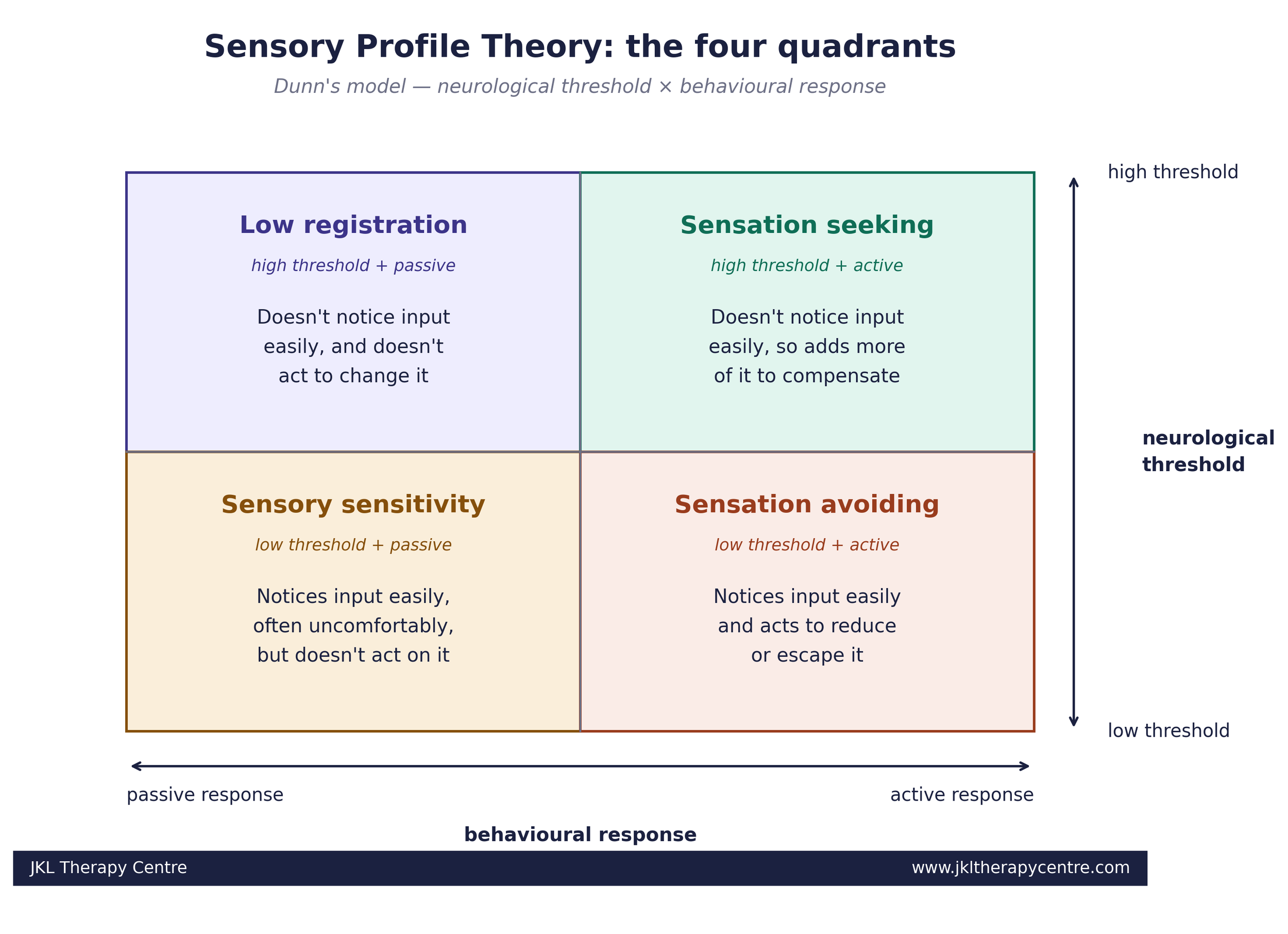
I find this distinction, threshold versus response, is the part clients grasp last but need most. Two people can have an identical neurological threshold and end up with completely different presentations, purely because of what they do in response to it. That's clinically useful because it means the behaviour (withdrawing from touch, craving deep pressure, needing the radio off) is often more changeable than the underlying threshold. We're not trying to alter someone's nervous system; we're helping them build a more deliberate, less costly response to it.
I teach this quadrant model as a lens, not a label. Almost nobody sits in one quadrant across every sense, a client might be a sensory seeker for movement and touch, and sensory avoidant for sound and smell, all at once. The senses exercise I've written about previously exists precisely to map that variation sense by sense, rather than assigning someone a single overall "profile."
Why I'm starting this series with interoception
Of the eight senses covered in that mapping exercise, interoception is the one I now spend the most time on clinically, for a simple reason: it's the sense that governs whether a client can notice their own emotional and physical states clearly enough to work with them at all. Attention, sensory sensitivity, even sexual response, all of it sits downstream of interoception. If a client can't accurately register "I'm anxious" or "I'm aroused" or "I'm full" in the moment, no amount of Sensate Focus scripting will land, because the raw data the exercise depends on isn't reaching conscious awareness in the first place.
What interoception actually is
Interoception is the sense of the internal state of the body, heartbeat, breathing rate, muscle tension, hunger, thirst, the need to use the toilet, and crucially, the early physical signatures of emotion (the tightness of anxiety, the warmth of arousal, the heaviness of sadness). Physiologically, it's carried largely through vagal afferent signals and processed heavily in the insular cortex, which is also deeply involved in emotional awareness, which is part of why interoceptive differences and emotional-regulation difficulties so often travel together clinically.
As with the other senses, interoception sits on the same threshold-and-response spectrum. Some clients have a low interoceptive threshold, they register internal signals early and often intensely, sometimes to the point of being flooded by bodily sensation before they can make sense of it. Others have high interoceptive thresholds, signals simply don't register until they're extreme. A client with high-threshold interoception might not notice hunger until they're lightheaded, might not notice rising anger until it's already at the surface, or might not notice arousal building until a partner is well ahead of them and feeling confused by the mismatch.
Where this shows up in the therapy room
I see interoceptive differences constantly in psychosexual and relationship work, usually before either partner has language for what's happening:
A client who says "I don't really know what I want, sexually" isn't necessarily avoidant or disconnected from their partner, they may genuinely not be receiving clear internal signals about desire until they're already highly aroused.
A client who seems to "shut down" suddenly during Sensate Focus may not be dissociating from discomfort in the way it looks; they may be experiencing a delayed, high-threshold registration of overwhelm that arrives all at once rather than gradually.
A partner who complains "you never tell me when something's wrong until it's a crisis" is often describing, in relationship terms, exactly what low interoceptive registration looks like from the outside.
Alexithymia, difficulty identifying and describing one's own emotions, overlaps substantially with interoceptive difficulty, and is common enough among ND clients that I now consider it routine to screen for informally, well before assuming a client is being evasive or under-invested in the work.
None of these are failures of insight, honesty, or motivation. They're differences in a sense most clients have never been taught to name, let alone monitor deliberately.
How I work with interoceptive differences clinically
A few strategies I return to repeatedly:
External scaffolding before internal awareness. For clients with high interoceptive thresholds, I introduce external check-in points: a timer, a habit of pausing at set moments during intimacy, rather than relying on internal sensation to prompt the pause. The goal is to build the check-in into a routine until it doesn't depend on catching a signal that isn't reliably arriving.
Body mapping and graded attention. For clients whose interoception is present but unpractised, I use body-scanning exercises that start broad (torso, whole-body warmth) before narrowing to more specific signals (heartbeat, breath, muscle tension), building the skill of noticing gradually rather than expecting immediate fine-grained awareness.
Slowing the window between signal and flooding, for clients at the low-threshold end. Here the work is less about noticing more and more about tolerating the signal without needing to escape or shut down the moment it arrives, closer to distress-tolerance work than to attention-building.
Naming it as physiology, not character. I've found that simply explaining interoception as a distinct, measurable sense, rather than a matter of emotional intelligence or self-awareness "effort", does a great deal to reduce the shame clients often carry into these conversations, particularly those who've previously been told they're "out of touch with their feelings."
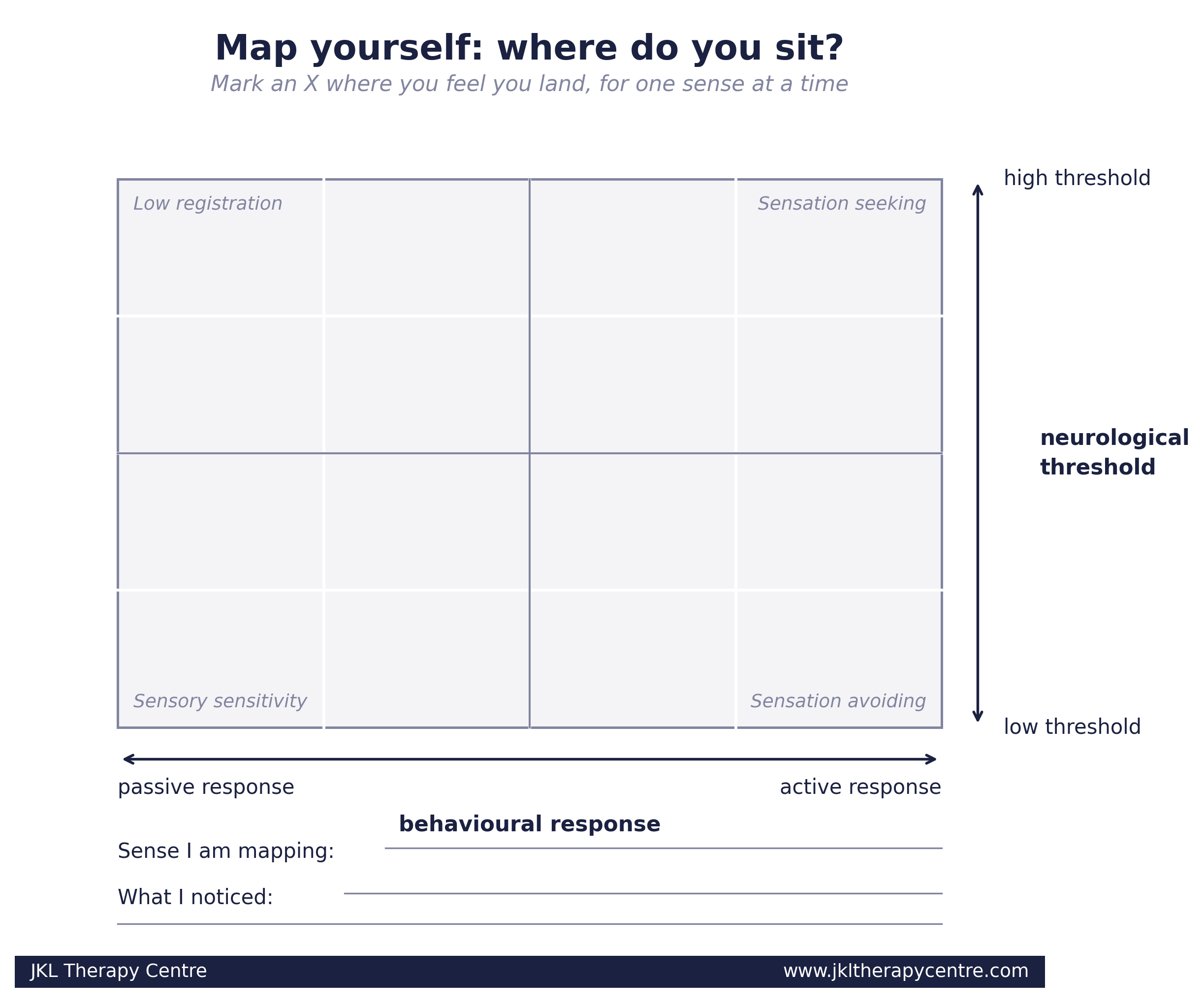
Map yourself. Download the companion worksheet and mark where you land on each sense, one at a time: no clinical background needed, just a pen and a few honest minutes. [Download the PDF] and start using it today.
What's next in this series
This piece has deliberately gone deeper into one sense than the original article had room for. The next instalments will do the same for the remaining senses in turn, starting with touch and the vestibular sense, both of which come up constantly in Sensate Focus work, before moving through taste, smell, sight, hearing, and proprioception. Each will follow the same structure: the theory as I teach it, why that particular sense matters clinically, and how I actually work with differences in it in the room.