Senses Series, Part Two: Touch and the Vestibular Sense. A Guide for Clients and Therapists
Autism Spectrum · ADHD · AuDHD · Sensory Profile · Psychosexual & Relationship Therapy
Who this is for
I'm writing this article for two audiences at once, deliberately. If you're a client, you should be able to read this and recognise yourself in it without needing a clinical background. If you're a therapist or fellow practitioner, you should find enough theoretical grounding here to use it in your own work. Where I use a technical term, I'll explain it in plain language the first time it appears.
A starting principle
Before anything else: sensory processing differences are not malfunctions to be corrected. This is the position taken by occupational therapy researchers working in the neurodiversity-affirming tradition, and it's the one I hold clinically, sensory processing is understood as neutral, and the therapeutic task is to adjust environments and build supportive strategies around a person's actual processing style, not to change the underlying nervous system itself. I want that stated plainly before we go further, because a great deal of unhelpful shame gets built on the opposite assumption.
The theory, briefly recapped
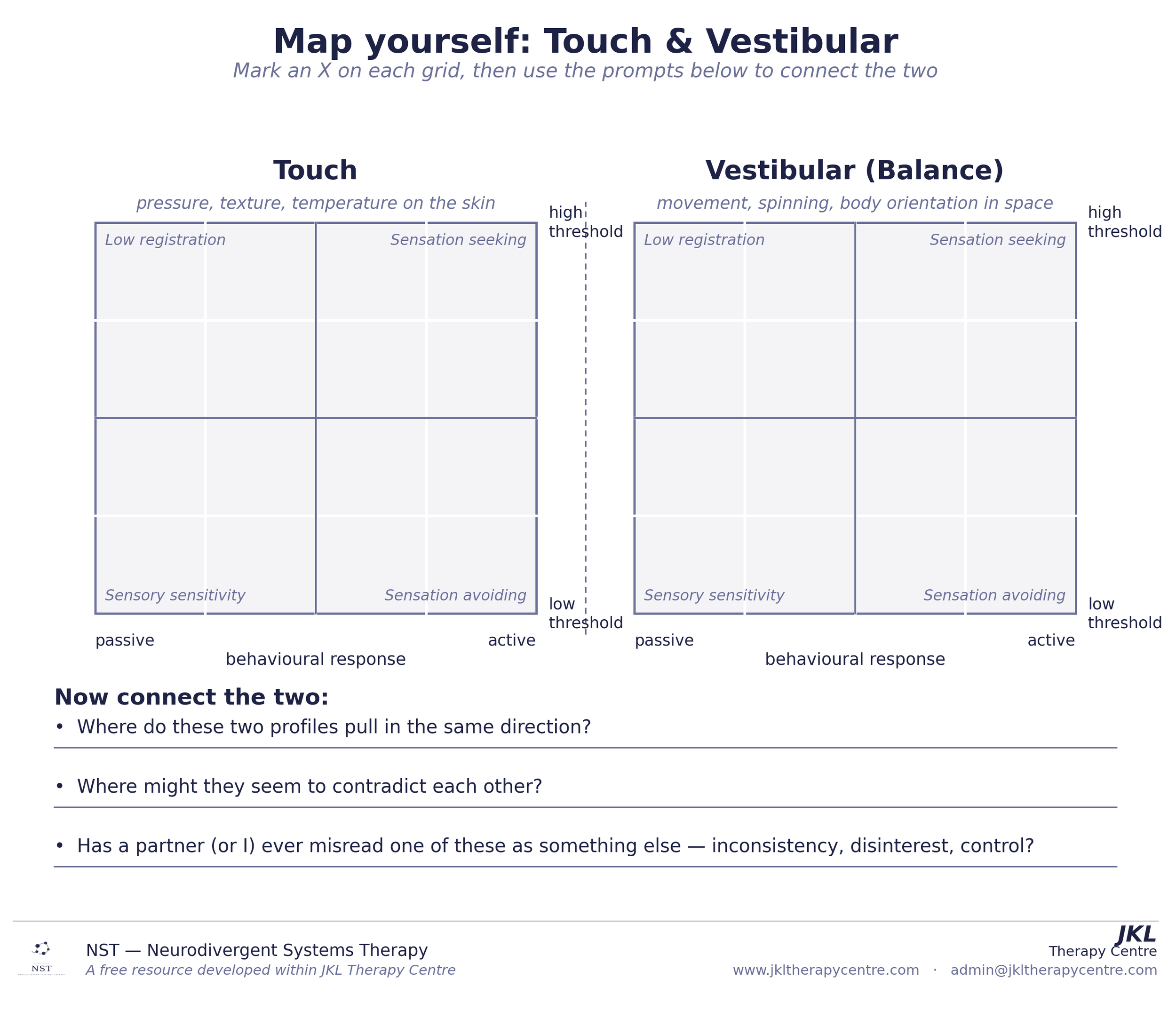
The previous article in this series introduced Dr Winnie Dunn's model of sensory processing, developed within occupational therapy and now widely used across clinical settings. The model describes two things about a person, each on its own continuum: their neurological threshold (how much sensory input it takes before something registers) and their behavioural response (whether they act to seek more input or to reduce it). Crossing these two continuums produces four recognisable patterns: sensation seeking, low registration, sensory sensitivity, and sensation avoiding, which I mapped out visually in the quadrant chart accompanying the interoception article.
This paper applies that same model to two senses at once: touch, because it's the literal medium of Sensate Focus work, and the vestibular sense, because it's the one most often missing from the conversation entirely, despite quietly shaping how safe or unsafe touch and intimacy can feel.
A note on diversity within diagnosis
Autistic clients, ADHD clients, and AuDHD clients do not share a single sensory profile. I see markedly different presentations across all three, often within the same diagnostic label, a touch-avoidant autistic client and a touch-seeking autistic client are both entirely typical of the diversity within autism, not exceptions to some single "autistic pattern." Everything below describes tendencies worth planning around, never a rule I apply to a client before mapping their profile with them directly.
Touch, through the quadrant model
Touch threshold and touch response combine independently, producing four distinct presentations:
Tactile seeking (high threshold, active response), often wants firmer pressure, more varied texture, or more prolonged contact than a partner expects; gentler touch can register as vague or under-stimulating.
Tactile low registration (high threshold, passive response), may simply not notice a partner's touch has started, stopped, or changed, which can read to a partner as inattentiveness when it's actually a registration difference, not a caring one.
Tactile sensitivity (low threshold, passive response), touch registers easily, sometimes uncomfortably, but the person doesn't act to change it, often masking discomfort rather than naming it, particularly common in clients who've previously been told they were "too sensitive."
Tactile avoiding (low threshold, active response), touch registers strongly and the person moves, flinches, or asks for it to stop.
In practice, tactile presentation frequently varies by location on the body rather than being uniform: sensation-seeking on the forearms, acutely sensitive at the neck, in the same person. This is one of the strongest clinical arguments for body mapping before beginning any graded touch protocol, rather than assuming one profile head to toe.
The vestibular sense - the one nobody's asked about
Of the eight senses in the wider mapping exercise, the vestibular sense is the one I most often have to introduce from scratch, because almost no client has been asked about it before. It's the inner ear's sense of movement, spinning, tilting, and where the body sits in space relative to gravity, it's what tells you you're upside down with your eyes closed.
Its relevance to intimacy work isn't obvious until you look for it, but it shows up reliably:
Vestibular seeking clients are often drawn to positions involving rocking, swaying, or being physically moved by a partner, and can find stillness oddly unsatisfying or hard to settle into.
Vestibular sensitive or avoidant clients may experience a disproportionate anxiety response to certain positions, particularly ones involving being off-balance, inverted, or unable to see a stable horizon, that has nothing to do with the emotional content of the moment and everything to do with the inner ear.
Vestibular processing and interoception draw on overlapping neural pathways involved in bodily self-monitoring, which is why vestibular dysregulation and difficulty accurately reading one's own arousal or anxiety often travel together.
I've worked with more than one couple convinced a specific position simply "wasn't working for them" sexually, when the underlying issue was one partner's vestibular sensitivity to the head position involved, resolved, once named, in a few minutes of conversation rather than months of avoidance.
Where the two senses interact and where relationship difficulty often actually lives
Touch and the vestibular sense rarely operate independently in the room, and this is where I see the clearest intersection with psychosexual and relationship presenting problems. A client who is tactile-seeking but vestibular-avoidant may want intense, firm touch, but only in positions where their base of support feels completely stable, meaning the same person can present as "wanting more" in one context and "controlling about position" in another, when both come from the same underlying sensory logic. Left unnamed, this pattern is frequently misread by a partner as inconsistency, rejection, or a communication failure, when it's a coherent sensory need that's simply never been mapped.
This matters beyond the bedroom, too. Couples I see often arrive describing the relational fallout of unmapped sensory differences, resentment over "never getting a straight answer" about what feels good, or hurt at being pulled away from mid-touch, without either partner having language for what's actually happening physiologically. Naming the sensory pattern tends to do more to de-escalate that resentment than any communication technique I could teach on top of it.
Working with this clinically
A few adjustments I make routinely, always starting from a client's own mapped profile rather than an assumption based on diagnosis:
Graded touch exercises built around location, not just intensity. Rather than one uniform pressure level, couples map which zones want more input and which want less, and the exercise sequence is built around that map.
Vestibular considerations named before position is discussed. For vestibular-sensitive clients, I introduce the concept early and explicitly, framing position preference as physiological rather than as a lack of adventurousness or a relational complaint.
Stability as a baseline requirement, not an accommodation. For vestibular-sensitive clients, a stable base of support is treated as a precondition for exercises to work at all.
Naming the overlap for the couple. When a client's presentation looks contradictory, wanting firm touch but resisting certain positions, hearing that this is a coherent sensory pattern, rather than a mixed signal, is consistently one of the most relieving moments in session.
Map yourself: two free tools
You don't need a clinical background to start this work. I've built two free companion tools for this series:
The interactive senses radar, an online tool where you (or you and a partner) can mark where each of you sits across all nine senses at once, and see the shape of your differences visually.
The "Map Yourself: Touch & Vestibular" worksheet, a printable PDF version of the same threshold-and-response chart used throughout this series, for anyone who'd rather work through it with a pen, alone or between sessions.
Both are free to use, for yourself or with clients, starting today.
What's next
The next article in this series turns to proprioception, the sense of where your body is and how much force you're using, without looking and its close ties to grounding, deep pressure, and the self-regulation strategies many neurodivergent people have already discovered for themselves, often without a name for what they were doing or why it worked.
Further reading: W. Dunn's model of sensory processing (Dunn, 1997; 2001) is the theoretical basis for the quadrant framework used throughout this series.