Senses Series, Part Three: Proprioception - Grounding, Deep Pressure, and Self-Regulation
Autism · ADHD · AuDHD · Dyspraxia/DCD · Sensory Profile · NST
Who this is for
As with the rest of this series, I'm writing for clients and therapists at once. If you're a client, you shouldn't need a clinical background to recognise yourself here. If you're a colleague, there's enough theoretical grounding to use this directly in your own work.
A quick note on scope
This series has focused mostly on autism, ADHD, and AuDHD so far, but proprioception is a sense where I want to widen that lens deliberately. Difficulty with proprioception: body awareness, coordination, knowing where your limbs are without looking, is a defining feature of developmental coordination conditions (dyspraxia/DCD), not just a feature that sometimes co-occurs with autism or ADHD. If you're dyspraxic, dyslexic, dyscalculic, or otherwise neurodivergent in a way this series hasn't named directly yet, this article is very much for you too.
What proprioception actually is
Proprioception is your sense of where your body is in space - the position of your limbs, the amount of force you're using, whether you're standing, leaning, or off-balance - without needing to look. It's carried by receptors in your muscles and joints, feeding the brain continuous information most people never consciously notice.
Research estimates a substantial proportion of autistic people - some studies suggest 30–50% - report proprioceptive differences, with comparable rates of coordination and body-awareness difficulty reported in ADHD populations. In dyspraxia/DCD, proprioceptive and motor-planning differences are the central feature the diagnosis describes, rather than a secondary trait.
Threshold and response, applied to proprioception
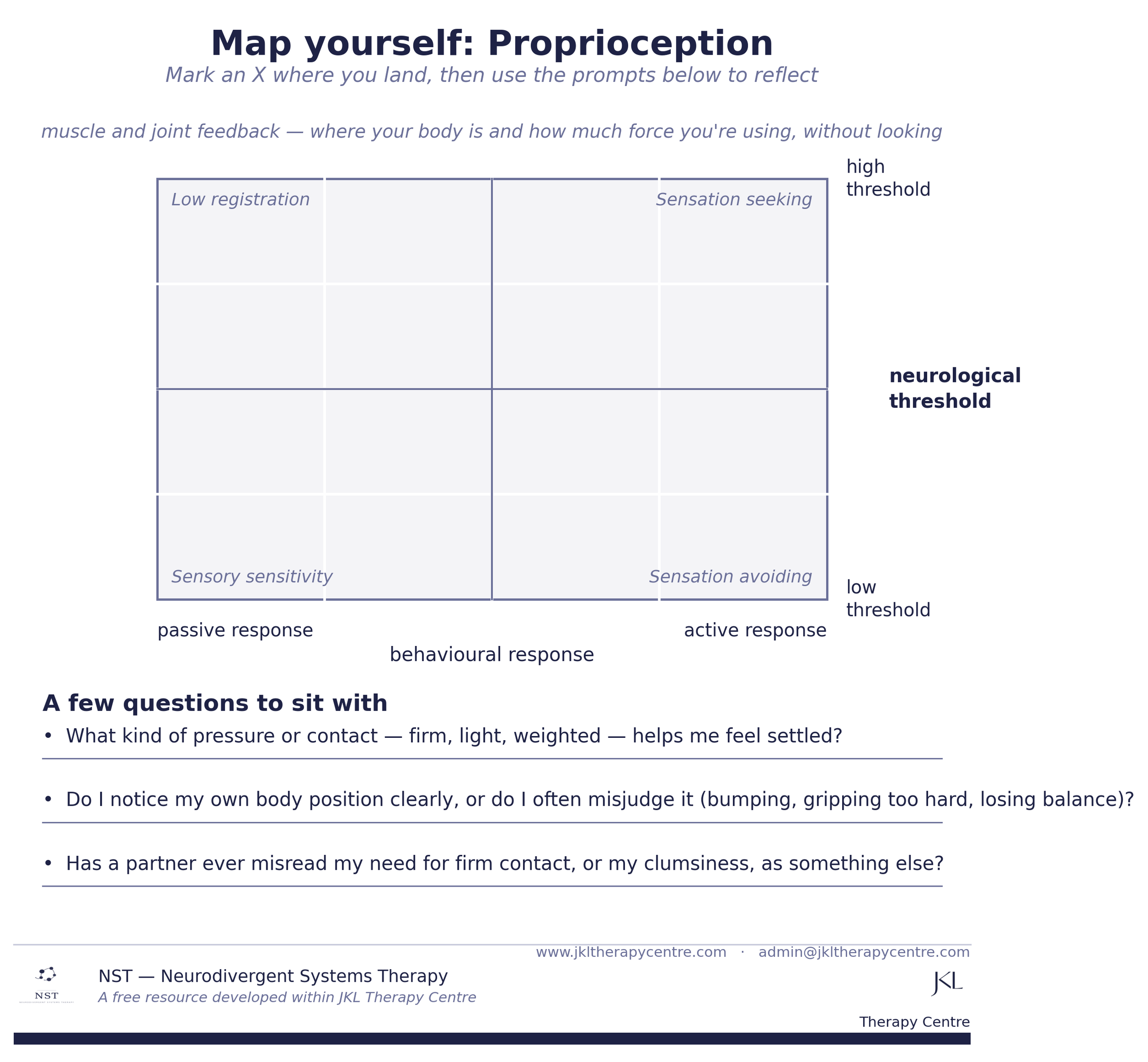
Using the same model from earlier in this series: proprioceptive threshold (how much input it takes to register where your body is) and behavioural response (seeking more input or avoiding it) combine into recognisable patterns:
Proprioceptive seeking: craving deep pressure, tight hugs, weighted blankets, or "heavy work" like pushing, pulling, or carrying. This is frequently described by clients as calming rather than stimulating, which surprises people expecting sensory seeking to always mean more arousal.
Proprioceptive low registration: under-noticing body position, which can present as clumsiness, bumping into things, or misjudging how much force a movement needs (gripping too hard, stepping too heavily) That’s definitively me :).
Proprioceptive sensitivity or avoiding: discomfort with firm touch, pressure, or certain movements, sometimes alongside a preference for very light or minimal contact.
Many neurodivergent adults already use proprioceptive strategies intuitively, often without a clinical name for what they're doing. Stimming: rocking, hand-flapping, pacing, is one of the clearest examples: current understanding treats it as a legitimate proprioceptive regulation strategy, not a behaviour to suppress. If a repetitive movement genuinely helps someone think or settle, the movement is doing real regulatory work, not just "looking different."
The physiology behind why this works
Deep pressure and proprioceptive input aren't just subjectively calming, there's a physiological mechanism behind it. Deep touch pressure appears to shift the nervous system toward parasympathetic activity (rest-and-digest) and away from sympathetic activity (fight-or-flight), which connects directly to the arousal-and-interoception diagram earlier in this series: proprioceptive input is one of the more reliable ways to move a dysregulated nervous system back toward a regulated state, rather than waiting for regulation to happen on its own.
This matters clinically because it reframes proprioceptive seeking as an active coping strategy rather than a symptom. A client who needs a tight hug, a weighted blanket, or firm pressure before or after intimacy isn't being demanding or high-maintenance, they may be doing genuinely effective physiological self-regulation, in a form that simply hasn't been named as such.
Where this shows up in psychosexual and relationship work
Proprioception intersects with intimacy work more directly than almost any other sense, because so much of touch-based practice: Sensate Focus included, assumes a baseline of body awareness that not every client has.
Proprioceptive seekers often want firm holds, compression, or weighted contact during intimacy, not as an intensity preference in the way people usually think about it, but as a genuine regulatory need. Naming this explicitly helps partners understand that "hold me tighter" may be a nervous-system request, not an escalation.
Proprioceptive low registration can look like a client "struggling to coordinate limbs" during sex, misjudging pressure with a partner, or seeming distracted or clumsy during physical intimacy, easily misread as disinterest or lack of presence, when it's a body-awareness difference.
Dyspraxic clients specifically may need more explicit verbal guidance during physical intimacy than other clients, not because they're not attending, but because proprioceptive feedback that most people rely on automatically simply isn't as reliable a source of information for them.
Proprioception and the vestibular sense (covered in Part Two) frequently interact: a client seeking deep pressure but avoiding certain positions may be managing two different sensory needs at once, not sending a mixed signal.
Working with this clinically
A few approaches I return to:
Naming proprioceptive seeking as regulation, not demand. Simply explaining the physiology, deep pressure shifting the nervous system toward calm, tends to reduce a partner's frustration at "always needing to be held a certain way" faster than any communication reframe I could offer on top of it.
Building heavy work into pre-intimacy routines. For clients who regulate through proprioceptive input, a few minutes of heavy work (pushing against a wall, carrying something heavy) before an intimacy exercise can lower baseline arousal enough that the exercise itself becomes accessible.
Explicit verbal guidance for low-registration and dyspraxic clients. Rather than assuming a partner will "just know" from body language, I coach couples to build in more explicit verbal check-ins about position and pressure, treating this as a communication skill to practise, not a failure of intuition.
Distinguishing proprioceptive seeking from a need for control. These can look similar from the outside - both may involve a preference for particular positions or firm contact - but they come from different places, and conflating them tends to pathologise a genuine sensory need.
Map yourself: the companion tool
As with the rest of this series, there's a free companion worksheet for proprioception: mapping where you sit between seeking and avoiding, and what effect proprioceptive input has on your energy, using the same format as the earlier senses in this series.
What's next
The next instalment turns to sight and hearing together: the two senses most shaped by the physical environment itself, and the ones I think about most when it comes to designing a therapy room, and advising clients on their home environment, that actually works with their nervous system rather than against it.
References
Crane, L., Goddard, L., & Pring, L. (2009). Sensory processing in adults with autism spectrum disorders. Autism, 13(3), 215–228.
Effectiveness of vestibular and proprioceptive exercises in reducing hyperactivity in children with autism spectrum disorder: A randomized controlled trial. ScienceDirect (2025).
Dunn, W. (1997). The impact of sensory processing abilities on the daily lives of young children and their families: A conceptual model. Infants & Young Children, 9(4), 23–35.