Senses Series, Part Five: Taste and Smell - The Senses Psychosexual Work Overlooks Most
Autism · ADHD · AuDHD · Sensory Profile · NST
Who this is for
As with the rest of this series, I'm writing for clients and therapists together. If you're a client, you shouldn't need clinical training to see yourself here. If you're a colleague, there's enough theory to use this directly in your own work.
Why these two senses get skipped
Of all eight senses in this series, taste and smell are the ones I think psychosexual therapy talks about least, despite the fact that almost every account of arousal, attraction, and aversion touches on one or both. Kissing, oral sex, scent, the taste of skin or arousal - these aren't peripheral details, they're central to how a lot of people experience intimacy, and yet clients rarely have language for their own preferences here beyond "I like it" or "I can't."
A shared mechanism worth naming
Taste and smell are more entangled with each other than any other pair in this series, most of what we experience as "flavour" is actually smell, detected retronasally as we eat, with taste itself limited to sweet, salty, sour, bitter, and umami. This is worth explaining to clients directly: someone who says food "tastes bland" during a cold, or who finds a partner's scent inseparable from how appealing something tastes, isn't imagining the overlap. It's how the two senses are built to work together.
Applying the threshold-and-response model
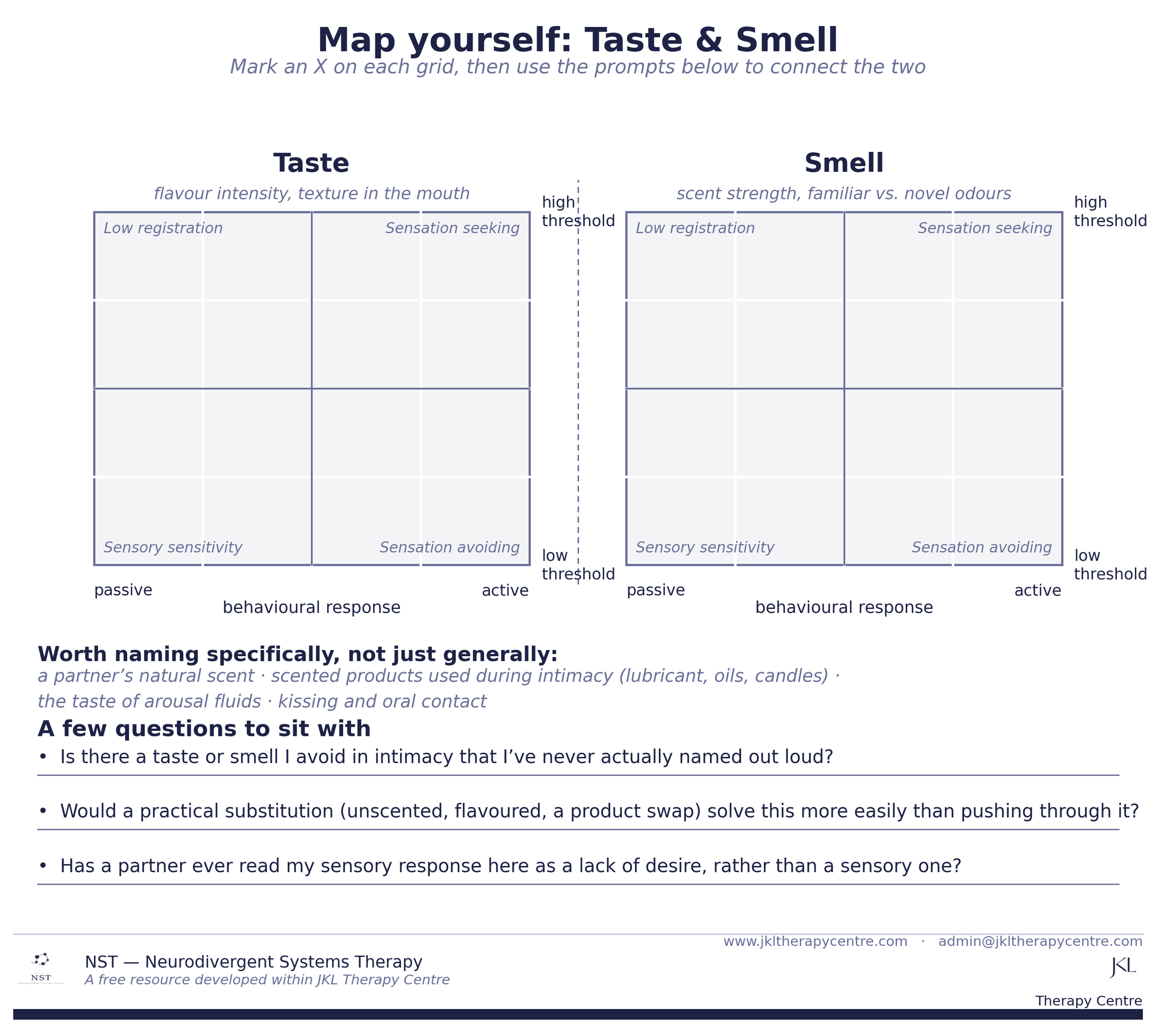
The same framework from earlier in this series applies to both senses:
Taste (gustatory):
Seeking: drawn to strong, intense flavours; may find mild food or gentle oral contact under-stimulating.
Low registration: may not notice subtle flavours or changes others pick up easily.
Sensitivity or avoiding: strong reactions to certain tastes or textures, often including a marked dislike of specific bodily tastes.
Smell (olfactory):
Seeking: drawn to strong scents; may actively seek out particular smells (a partner's natural scent, specific products) as part of what feels arousing or comforting.
Low registration: may not notice smells others react to strongly, including their own.
Sensitivity or avoiding: strong, sometimes involuntary reactions to scent, including scents most people don't consciously register at all.
What the research actually shows
Taste processing in autism has historically been understudied compared with the other senses, but recent work is catching up. A 2025 scoping review found consistent evidence of altered taste reactivity in autistic people across questionnaire and neuroimaging studies, with some evidence that this may involve brain regions typically associated with social processing being repurposed for sensory perception instead, a genuinely interesting finding, since it suggests taste sensitivity in autism isn't simply "more of the same" mechanism as in non-autistic people, but potentially a different neural pathway altogether.
On the smell side, research on odor novelty suggests unfamiliar scents may be processed differently by autistic people than familiar ones, which may partly explain why food or intimacy involving new or unexpected smells can provoke stronger reactions than something familiar, even at the same objective intensity.
A 2025 meta-analysis also confirms sensory processing differences, including gustatory and olfactory, are significantly more common in ADHD populations than in the general population, not just in autism. And taste, smell, and touch sensitivity together have been shown to meaningfully predict food selectivity, independent of other factors, reinforcing that this isn't "picky eating" in the dismissive sense, but a measurable sensory pattern.
A clinical note on food selectivity and ARFID
I want to flag this directly rather than skip past it: significant food selectivity driven by sensory sensitivity can, in some cases, meet criteria for avoidant/restrictive food intake disorder (ARFID), which co-occurs with autism at a notably higher rate than in the general population. This is a genuine clinical entity distinct from ordinary sensory pickiness, and it needs its own specialist assessment, it's not something this article, or a sensory mapping worksheet, is designed to evaluate. If a client's relationship with taste and food involves significant nutritional or physical risk, that's a referral, not a sensory-profile conversation.
Where this shows up in psychosexual and relationship work
This is where taste and smell matter most in my own clinical work, and where couples most often arrive without language for what's happening:
Oral sex and kissing are shaped directly by taste sensitivity. A client who avoids certain kinds of oral contact isn't necessarily avoiding intimacy or their partner, they may be responding to a genuine sensory aversion to specific tastes, including the taste of arousal fluids themselves, which is a documented and ordinary variation rather than a rare complaint.
Scent and arousal are tightly linked. A partner's natural scent can be central to attraction for a smell-seeking client, while the same scent or a partner's perfume, soap, or product choices can be genuinely aversive for a smell-sensitive one. Neither response is a judgement on the partner; it's a nervous system responding to olfactory input the way it's built to.
Scented products used during intimacy, lubricants, candles, massage oils are an easy, practical place to intervene once a profile is named: unscented or flavoured options exist specifically for this reason, and simply knowing to look for them removes a source of friction that often gets misread as pickiness or a lack of interest.
Mismatched profiles between partners are common and rarely about desire. A taste-seeking partner wanting more intense contact and a taste-avoiding partner needing less are describing two different nervous systems, not two different levels of attraction to each other.
Working with this clinically
A few approaches I use directly:
Naming taste and smell as legitimate variables in an intimacy conversation, on the same footing as touch or lighting, most couples have never been invited to discuss this explicitly, so simply raising it as a normal topic does real work on its own.
Practical substitutions over pressure to tolerate. Unscented products, flavoured alternatives, or simply changing what's used rather than asking a sensitive partner to adapt to what's there.
Separating aversion to a specific sensory quality from aversion to the act itself. A client who finds a particular taste unpleasant may still want the same intimacy through a different route, this is a sensory substitution conversation, not a motivation or desire conversation.
Screening lightly for ARFID-level food selectivity when sensory eating patterns come up, and referring onward rather than treating it as part of the sensory-profile conversation.
Map yourself: the companion tool
As with the rest of this series, there's a free worksheet for mapping your own taste and smell profile: including space to separate general sensitivity from the specific intimacy-relevant details (arousal fluids, scented products, a partner's natural scent) that rarely come up in a standard sensory conversation.
What's next
This completes the sense-by-sense portion of this series: touch, vestibular, proprioception, sight, hearing, taste, and smell, alongside the interoception piece that opened it. The next article steps back and asks a different question: what if the same seeking-and-avoiding pattern applies not just to sensory input, but to emotional experience itself? That piece draws on everything this series has built so far, and I've been holding it until the vocabulary was fully in place.
References
Goldschlager, J., Cintron, C., Hall, R., et al. (2025). Taste processing in autism spectrum disorder: A translational scoping review. Neuroscience & Biobehavioral Reviews, 170, 106031.
Jurek, L., Duchier, A., Gauld, C., et al. (2025). Sensory Processing in Individuals With Attention-Deficit/Hyperactivity Disorder Compared With Control Populations: A Systematic Review and Meta-Analysis. Journal of the American Academy of Child and Adolescent Psychiatry.
Food selectivity in Autism Spectrum Disorder: implications of eating, sensory and behavioural profile. Frontiers in Psychiatry (2025).